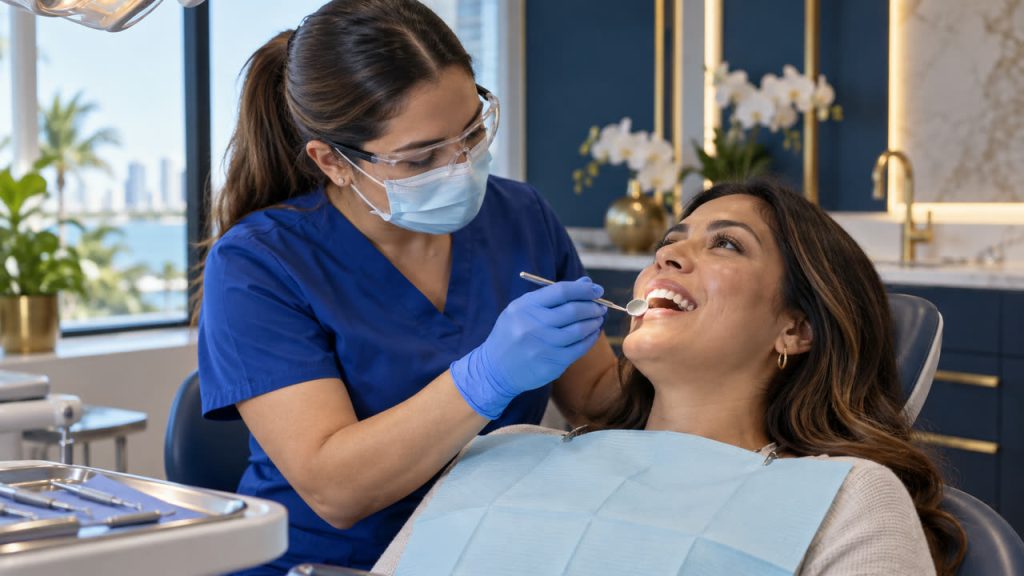
Gum disease treatment in Lake Worth usually starts with a gum exam and, for many adults, a deep cleaning. Early gum disease rarely hurts, so most people don't notice it until their gums start to pull back or a tooth feels loose. Early gum disease responds well to treatment. At Cagigas Dental we measure your gums and give you a written plan before any treatment starts.
Early Signs of Gum Disease
Gum disease is an infection of the tissue that holds your teeth in place. Bacteria in plaque inflame the gums, and plaque left along the gumline hardens into tartar. You can't brush tartar off at home, so the irritation keeps going.
According to the CDC, nearly half of adults 30 and older have some form of gum disease. It's a leading cause of adult tooth loss, and most people who have it feel no pain. Look for these signs:
- Gums that bleed when you brush or floss
- Swollen, tender or red gums
- Bad breath or a bad taste that keeps coming back
- Gums pulling back so your teeth look longer
- Teeth that feel loose, or a bite that feels different
- New gaps between teeth, or pus at the gumline
If your gums have been bleeding for more than a week or two, book an exam instead of waiting for your next cleaning. Measuring the gums takes a few minutes.
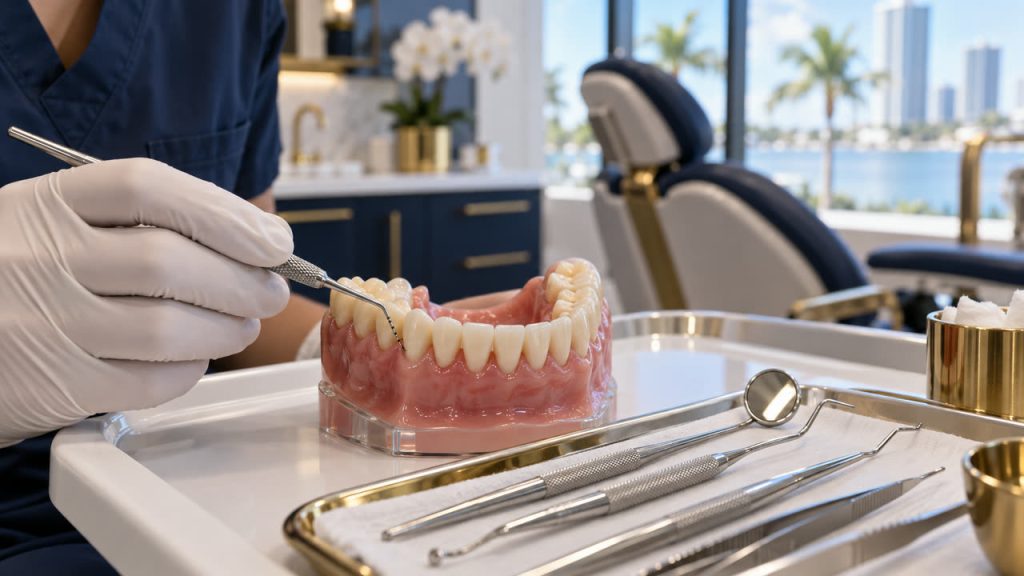
How Gum Disease Progresses From Gingivitis to Periodontitis
Treatment depends on how far the disease has gone.
| Stage | What is happening | Typical treatment |
|---|---|---|
| Gingivitis | Gums are inflamed and may bleed. The bone and fibers holding the teeth are still intact. | A professional cleaning plus better brushing and flossing. Usually reversible. |
| Early periodontitis | Bacteria have moved below the gumline and formed pockets. The bone starts to be affected. | A deep cleaning (scaling and root planing) and closer follow-up. |
| Moderate periodontitis | Deeper pockets, more bone loss, gums start to recede. | A deep cleaning, then maintenance visits every 3 to 4 months. |
| Advanced periodontitis | Significant bone loss. Teeth may loosen or shift. | A deep cleaning and, in some cases, a referral to a gum specialist or a plan to replace teeth. |
At your exam the dentist measures the space between each tooth and the gum, called the pocket depth. Healthy pockets are usually 1 to 3 millimeters. Pockets of 4 millimeters or more that bleed, or bone loss on your digital X-rays, point toward a deep cleaning instead of a routine one.
What Is a Deep Cleaning (Scaling and Root Planing)?
Scaling and root planing is the dental name for a deep cleaning. It's a standard first treatment for periodontitis.
- Scaling removes plaque and tartar above and below the gumline, inside the gum pockets.
- Root planing smooths the tooth roots so the gums can reattach more snugly and bacteria have less to hold on to.
- The area is numbed first with local anesthetic. Most patients feel pressure and vibration. It usually doesn't hurt.
For gingivitis, a routine cleaning plus better care at home is usually enough. Periodontitis needs the deep cleaning. It's billed separately and is often done over one or two visits, one side of the mouth at a time. Our teeth cleaning page lists routine cleanings, deep cleanings and periodontal maintenance.
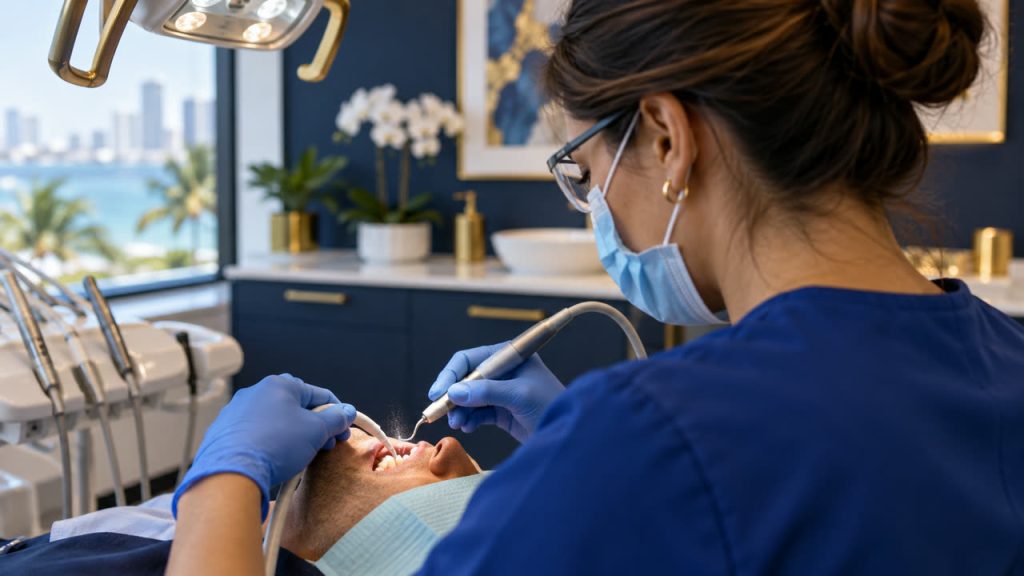
Gum Disease Treatment at Cagigas Dental, Step by Step
At our Lake Worth office, we can explain each step in English or Spanish.
- Exam and digital X-rays. The dentist checks your gums, measures the pockets and looks at the bone around each tooth.
- You get a diagnosis and a written estimate before any treatment.
- The deep cleaning is done with local anesthetic, usually in one or two visits.
- A few weeks later we measure again. Pockets usually get shallower and the bleeding goes down.
- If you've had periodontitis, you'll likely come back every 3 to 4 months instead of every 6.
New patients can start with the $79 new-patient special, which includes a comprehensive exam with digital X-rays plus a basic cleaning. If the exam shows you need a deep cleaning, Dra. Arianna Romero will go over the plan and the price with you first.
The $79 New-Patient Visit
A comprehensive exam with digital X-rays plus a basic cleaning. If you need a deep cleaning, you'll find out at this visit.
How Much Does Gum Disease Treatment Cost, and Does Insurance Help?
Deep cleanings are usually priced per quadrant, meaning a quarter of the mouth. Without insurance, expect roughly $200 to $400 per quadrant in the Lake Worth and West Palm Beach area, or about $800 to $1,600 for the full mouth. You'll get the exact number in writing after your exam.
- Many PPO plans cover part of scaling and root planing, often as a basic service. We take most major insurance plans and check your benefits for free.
- If you don't have insurance, ask about our self-pay rates or read our guide to dentist costs without insurance in Lake Worth.
- We offer financing through four lenders (CareCredit, Alphaeon Credit, Sunbit and Cherry). If an application is denied, we try the next lender. Each lender handles its own approvals.
Left untreated, periodontitis can end in loose or lost teeth, and replacing a tooth with a dental implant costs far more than a deep cleaning.
How to Keep Gum Disease From Coming Back
After treatment, you'll do most of your gum care at home.
- Brush twice a day with a soft brush angled toward the gumline.
- Clean between your teeth every day. Floss, a water flosser or small interdental brushes all work.
- Come in for cleanings every 6 months with healthy gums, or every 3 to 4 months after periodontitis treatment.
- Don't smoke. It's one of the biggest risk factors for gum disease, and it slows healing.
- If you have diabetes, keeping your blood sugar in range helps your gums too.
- Tell us early if the bleeding or sensitivity comes back.
For regular cleaning prices, see how much a dental cleaning costs in West Palm Beach.

Tooth pain instead of gum pain? See what your toothache may mean and how to ease it until your visit.
Resumen en Español
¿Le sangran las encías al cepillarse? Puede ser gingivitis o periodontitis, la enfermedad de las encías. Al principio casi no duele, y por eso mucha gente no la nota hasta que la encía se retira o un diente se afloja. En Cagigas Dental, en Lake Worth, le medimos las encías, le tomamos radiografías digitales y le explicamos en español si necesita una limpieza normal o una limpieza profunda (raspado y alisado radicular). La limpieza profunda se hace con anestesia local y quita el sarro que está debajo de la encía. Aceptamos la mayoría de los seguros y verificamos sus beneficios sin costo. Si es paciente nuevo, puede empezar con el especial de $79, que incluye examen con radiografías digitales y una limpieza básica. Si le interesa mejorar su sonrisa, lea nuestra guía de carillas de porcelana en Lake Worth. Llámenos al (561) 814-2888. Estamos en 2311 10th Ave N, Suite 14, Lake Worth, FL 33461.
Frequently Asked Questions
Can gum disease be reversed?
Gingivitis, the early stage, usually can with a professional cleaning and better brushing and flossing. Periodontitis can't be fully reversed because lost bone doesn't grow back on its own, but a deep cleaning can stop it from getting worse.
Does a deep cleaning hurt?
The area is numbed first. Most people feel pressure and vibration, and it usually doesn't hurt. Your gums may be sore and your teeth a bit sensitive for a few days afterward.
How long does a deep cleaning take?
Usually one or two visits, often one side of the mouth at a time. Each visit takes about one to two hours.
How much is a deep cleaning in Lake Worth without insurance?
A deep cleaning usually costs $200 to $400 per quadrant in the Lake Worth and West Palm Beach area. We give you an exact written estimate after your exam, and we offer self-pay rates and financing.
How often should I get a cleaning if I have gum disease?
Usually every 3 to 4 months instead of every 6, so we can catch it early if it starts coming back.
Bleeding gums? Book a gum exam.
Cagigas Dental is at 2311 10th Ave N in Lake Worth, a few minutes from West Palm Beach. We see patients in English and Spanish.